
Correct Installation of the Relief Air Plenum Pressure Sensor
Miles Ryan, P.E., writes a monthly column in Engineered Systems Magazine on Building Commissioning. Read April’s column below:
A common component of a control strategy for a recirculating AHU with a return fan, is to incorporate a relief air plenum pressure sensor. This sensor is at times used for monitoring only, but also often utilized for control of the relief air damper or return fan. See Figure 1. This article is written in the context of the relief air damper controlling to maintain that sensor reading at a prescribed setpoint, however all of the points made regarding the installation of the sensor apply to when the return fan is modulated to maintain that sensor reading at setpoint.
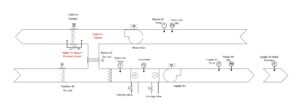
Figure 1: AHU with ducted relief air. Relief plenum pressure low port needs to reference air downstream of relief air damper.
The Intent
The rationale for having the relief air damper control for that pressure is to ensure that the relief damper remains closed when a negative pressure is being experienced in the relief air plenum. If that damper were to be open in such scenarios (which can often be the case in control strategies that do not incorporate this component), then air will be sucked in backwards through the relief air duct. Essentially, the relief air duct becomes a second outdoor air duct but the quality of this “outdoor air” is questionable in many instances.
Codes will not have as many limitations for placement of the relief air louver when compared to an outdoor air louver. Additionally, many times the relief air from multiple AHUs may share a common relief air louver. Therefore, sucking air backwards through the relief air duct may pose significant air quality concerns.
The Common Misapplication of this Sensor
Where this strategy becomes ineffective, is when the low pressure reference port for the differential air pressure transducer is not measuring the correct reference pressure. Flow direction through that relief air damper will be dictated by the relationship (positive or negative) of the differential pressure across that damper. Therefore, best practice would be to use the downstream side of the relief air damper as the low pressure reference for the transducer.
Scenario 1: Ducted Relief with the AHU Located in Mechanical Room
It is common for the low pressure port to be specified and/or installed referencing the mechanical room which the AHU is sitting in. If the relief air is ducted to the outdoors, this is not going to work correctly. The mechanical room pressure would not be representative of the pressure downstream of the relief damper.
If a mechanical room’s absolute pressure trended higher than the absolute pressure downstream of the relief air damper, the relief air damper will stay closed for longer than it should upon a rising economizer signal (i.e. closing of the return air damper), which will make the return fan work harder than it needs to.
If a mechanical room’s absolute pressure trended lower than the absolute pressure downstream of the relief air damper, then the sensor’s differential pressure reading would be higher than it should. The relief damper may open prematurely, air would enter the relief plenum by traveling backwards through the relief air duct, the relief plenum differential pressure reading would actually increase when that happens, which would result in the relief damper opening further, and the whole process will spiral out of control. The control loop becomes unstable in such situations.
Scenario 2: AHU Relieves into Mechanical Room it is Located in
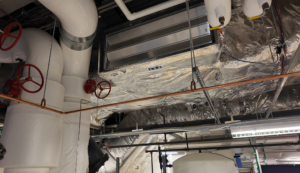
Photo 1: AHU relieving directing into a mechanical room.
Referencing the mechanical room air for the low pressure port would be fine if the unit relieved into the mechanical room, because the mechanical room pressure is representative of the relief air damper’s downstream pressure in this scenario. In many cases, referencing the mechanical room may be the only option with this type of AHU configuration, see Photo 1. This configuration usually incorporates a separate system for control of mechanical room pressure. One such example would be a separate mechanical room relief air damper which controls to a differential pressure across it. See Figure 2. When the AHU starts relieving into the mechanical room, the mechanical room pressure builds in reference to the outdoor air and that additional mechanical room relief damper eventually opens.
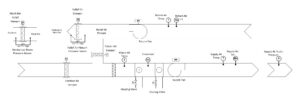
Figure 2: AHU relieving directing into a mechanical room. Relief plenum pressure low port can reference mechanical room in this instance, since that pressure is representative of the downstream pressure of the AHU’s relief air damper. Mechanical room pressure control performed by a separate system.
For this configuration shown in Figure 2, it is imperative NOT to reference the AHU’s relief plenum pressure sensor’s low port to the outdoor air. I have seen that attempted, with the AHU’s relief plenum pressure setpoint set higher than the mechanical room pressure setpoint. In theory that could work. The risk here is that the setpoints could be incorrectly adjusted, become uncoordinated and the approach will cease to work.
Since the AHU’s relief air plenum pressure transmitter was physically located at the control cabinet in the mechanical room, we merely unhooked the low reference tube leading to the outdoors and plugged it.
Scenario 3: RTU Located Outside
Referencing the outdoor air as the low pressure port would be fine in this scenario since the outdoor air pressure is representative of the downstream pressure of the relief air damper. RTUs would rarely have the air ducted downstream of the relief air damper.
Additional considerations
When implementing this approach, the control strategy for the relief air damper needs to be coordinated with the return air damper so that a faulty sensor reading does not result in both dampers closing and deadheading the return fan.
Along those lines, an in-unit static pressure safety switch which measures the relief plenum pressure relative to the mechanical room (or ambient if an RTU) is advised to disable the entire unit should the lower of the pressure rating of the unit, or the deadheaded differential pressure of the return fan, be exceeded.
Lastly, the relief plenum pressure sensor should be specified to be a bidirectional sensor, capable of reading both positive and negative values. This will provide more useful information to the building operator because there may be situations when the relief damper is fully closed. Having a negative reading on the relief plenum sensor being displayed on the BAS would provide the building operator with an explanation as to why the damper is closed.
Conclusion
Correctly referencing the relief air plenum pressure low port sounds trivial but is often incorrectly specified and/or installed. This has cascaded into many time consuming troubleshooting exercises. Taking the time to truly think it through can save many headaches. Hopefully these explanations will help commissioning providers better articulate the issue to design engineers and temperature control contractors.